



New
The Best Trade Is Often No Trade
I’m writing this for the version of me from years ago — the one who kept believing one more trade would win it all back. Most of the money I lost wasn’t in the trades I got wrong. It was in the trades I should never have taken at all. That, I’ve learned, is the quiet cost of overtrading — and it nearly emptied me before I understood it.
The Night I Understood: The Enemy Isn’t the Market
Eleven at night. I had shut the laptop. Brushed my teeth. Switched off the office light and told myself today was enough.
Then I walked back to the desk.
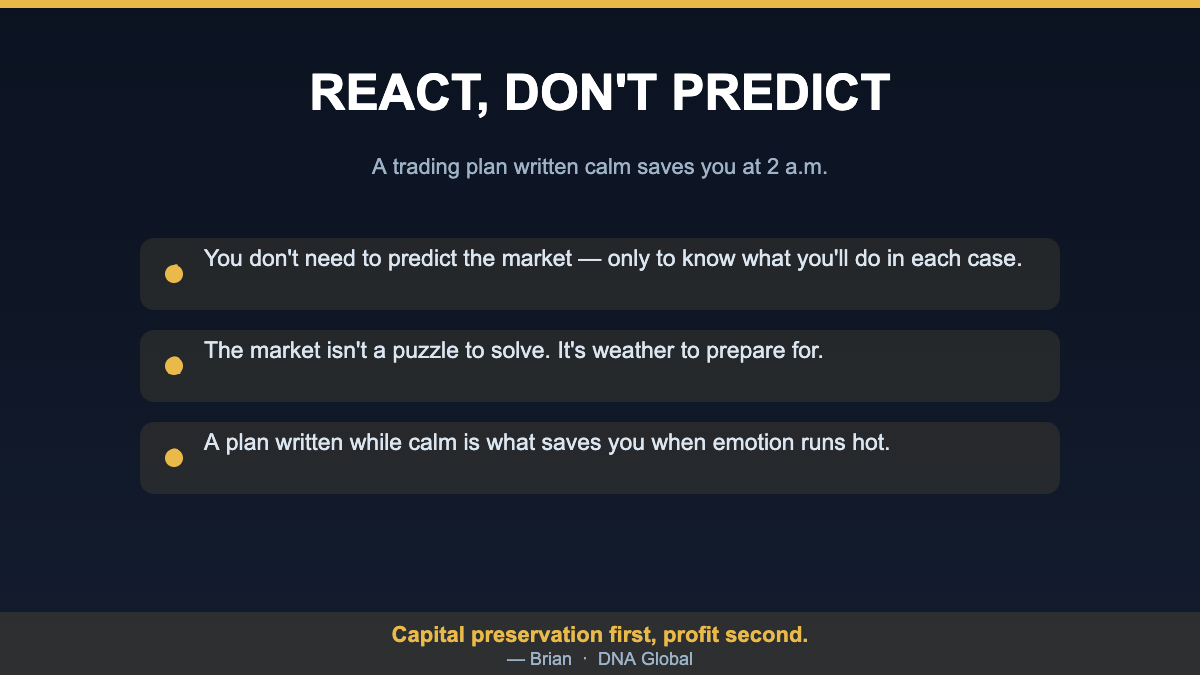
You know that moment? The one where you promise yourself “just a quick look.” The screen wakes up in the dark and throws that familiar cold blue light across my face. Gold is twitching. And my finger — not my head, my finger — starts drifting toward the Buy button.
A tired man hunched over a screen at an hour he should have been asleep. And a question I’d been dodging finally surfaced:
Am I entering because I see an opportunity — or because I can’t stand being on the sidelines?
My system was clear: nothing to do today. I entered anyway. Entered to win it back. Entered because my hands were itching. That feeling of sitting still clawed at my chest harder than any losing trade ever did. People call it overtrading. I call it by a truer name: not being able to stand the quiet.
That night was the most expensive look in the mirror of my life. I read my journal line by line and saw a cold truth: most of the times I blew up an account, I didn’t lose because I read the direction wrong. The direction, I often got right. I lost because I showed up somewhere I had no business being.
I didn’t lose because I was wrong about direction. I lost because I sat down in a chair that should have stayed empty.
The enemy doesn’t sit on the other side of the screen. It sits in my chair.
How to Stop Overtrading Starts With the Fear Underneath
I used to think I traded too much because I was greedy. That story was easier to live with. The truth was barer. Overtrading, plainly, is taking more trades than your system allows: one more, one to recover, one because your hands are restless. No setup was calling me. Just an itch under the skin: do something, don’t just sit there.
And here’s the part it took me years to admit: underneath that restlessness wasn’t greed. It was fear. A double fear. The first: fear of missing out — that the moment I stepped back, the market would launch the cleanest move of the day without me. The second runs deeper, and it’s more embarrassing: fear of admitting the market had nothing for me today. Because if I shut the laptop, I’d have to face a stinging question — or maybe I’m just not good enough? So I entered. To prove to the screen that I was still a working trader, not some helpless man sitting on his hands.
It turned out I wasn’t entering to make money. I was entering to escape a feeling.
My account didn’t die from a single bullet. It died from hundreds of pinpricks I gave myself — each one out of fear, not greed. There was no loss big enough to remember. Just dozens of small trades: a little spread, a little emotional error, a little focus drained from the one setup that mattered. They didn’t kill the account in a night. They made it bleed quietly, drop by drop, until I looked up and couldn’t account for where the money had gone. I paid tuition for this lesson. In real money. And in many nights lying awake asking who I was.
Quality Over Quantity: Counting the Trades I DIDN’T Take
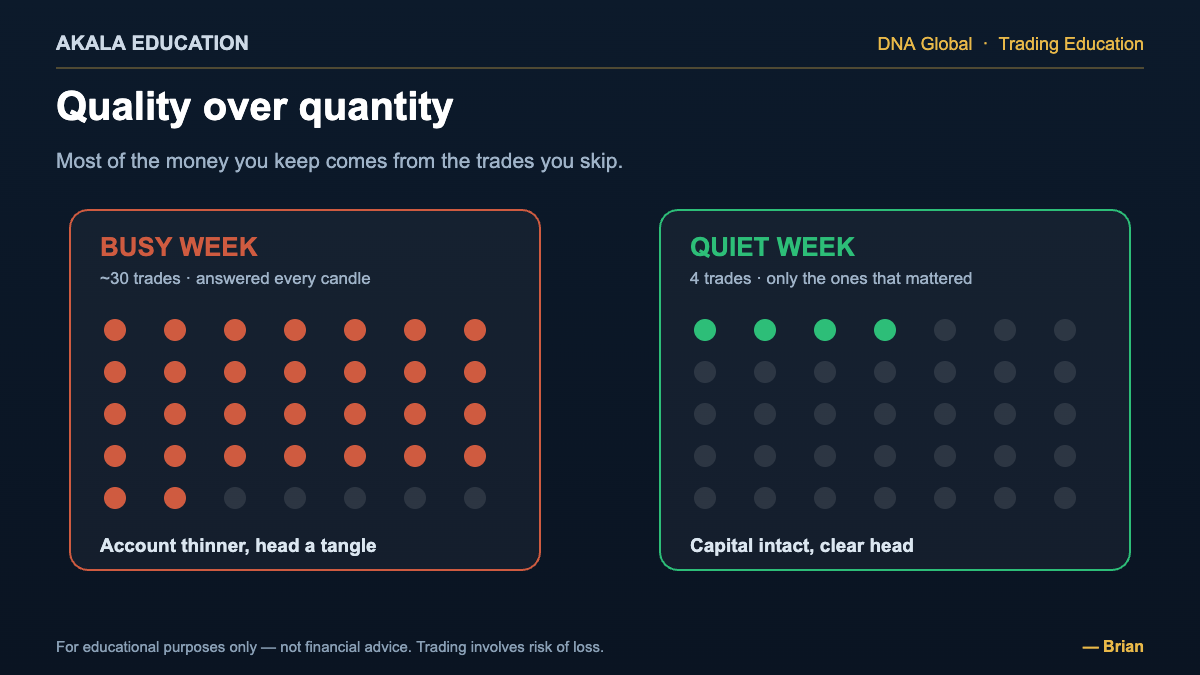
One morning I opened the notebook, and instead of writing “how many trades today,” I wrote a completely different question: how many trades did I NOT take today? It sounds backwards. But that was the day everything began to turn. For years I’d counted the wrong thing — trades taken, as if the number measured how hard I worked. I’d forgotten a plain truth: most of the money I kept didn’t come from the trades I took. It came from the trades I was clear-headed enough not to take.
So I changed the rules. I tore off a scrap of paper, wrote one line, and stuck it to my screen: “Standing aside is also a position.” Every time my finger drifted to Buy with no reason I could name, I looked up, pulled my hand back, and made a tally mark in the “trades not taken” column. Each mark was one time I didn’t drive a needle into my own arm.
I used to think photography was about cramming as much as possible into the frame. Wrong. A photograph gets better not from what you add — but from what you dare to cut. The best part of the picture is the part you leave outside the frame. Charts are the same. So is an account.
Then I laid two weeks side by side. First week: thirty trades. Every red and green candle was a call, and I answered all of them. The next week: four. Guess which week I slept better? Not the thirty-trade one — by its end the account was thinner, my head a tangle, and I couldn’t even remember why I’d taken trade number seventeen. The four-trade week, the capital was more intact, the head lighter, and I remembered the reason behind every click.
I’m not selling you a formula — the market doesn’t owe anyone a promise. I’m only telling you what I lived. Each extra trade didn’t just eat a few dollars of spread. It ate something far more expensive — focus. Spread across thirty shabby setups, I had nothing sharp left for the one that deserved it when it came. Every junk trade is focus borrowed from the next decent opportunity — and that loan always charges interest.
A marathon runner doesn’t sprint at every kilometer. They conserve, read the road, save the kick for the stretch that truly needs it. Traders are the same. You don’t enter on every candle; you wait for the candle worth the risk. The problem was never that you take too few trades. It’s that you take too many that aren’t worth taking. Quality of one trade. Not quantity of trades.
That runs deep. But there’s a part deeper still — why we keep clicking, even knowing it’s one too many.
Busy Isn’t Good: The Best Trading Day Is a Boring One
I know that feeling. A whole day without a single trade, and by evening something tightens in your chest: “What have I been doing all day? Am I a real trader, or just a guy staring at a screen?” And to silence it, you take a trade — not because the setup is clean, but because you need to see your hands doing something. Let me say it straight, because back then I needed someone to and no one did: you’re not bad at this. You’re just confusing “busy” with “good.” The core of this craft isn’t action — it’s knowing when not to move.
Being busy on the chart isn’t skill. Most of the time, it’s impatience wearing the uniform of hard work.
I paid dearly to believe the opposite — months proud of “working hard,” app open at dawn, dozens of trades a week, all of it only proof I was afraid to sit still. This is the same discomfort I wrote about in The Hardest Click Is the Stop Loss — the fight isn’t with the chart, it’s with the hand. So if you sit a whole session without a trade and feel useless, hear me: that might be the session you got most right. You’re learning the thing most people here never learn — patience in trading, sitting still until it’s time.
Let me tell you about my best trading day last month. Not a single entry. I sat in front of the screen for four hours, watched each candle crawl past, drew zones and erased them. And the market never once handed me a decent reason to enter — the area I waited for didn’t get touched, the structure I needed never formed. Everything hung in the middle, pretty on the surface, hollow inside. So I did something the old me would have found insane. I shut the laptop, laced up my shoes, and went for a run.
That evening I opened the account: the number stood still. Untouched. And for the first time, I looked at that “untouched” as a goal scored — not a day thrown away. We’re wired to think the opposite. A day with no trades is a wasted day. But I paid tuition to understand this: the best day is usually quiet to the point of boring — and that boredom is discipline breathing. Staying out of the market isn’t doing nothing. It’s a “not yet” you repeat one candle at a time — heavier on the hands than entering ever is.
It’s like learning to swim. Beginners thrash hard, thinking the more they flail the more they move — and the more they thrash, the more they sink. Good swimmers let go: hold the form, let the water carry them. The market is the same. You don’t kick at every candle. You hold your form and let probability do its part.
I’m not saying I’m done. There are still nights my hand wants to click just because it can’t stand the silence — and I have to pull it back. I don’t beat the market. I beat the version of me that can’t sit still. I’m still walking.
Closing: The Best Trade Is Still No Trade
“The market took my money,” I used to mutter after every blown-up night — as if each line were a form I signed, applying to stay a victim one more day. Clicking constantly isn’t a bad habit; it’s the symptom of a man who handed the wheel of his life to a chart. So what is ownership? Not predicting the market right, but deciding right about yourself. The day you stop asking “what is the market about to do” and start asking “what am I allowing myself to do” — that’s the day the wheel comes back to your hands.
So tonight, one thing. Before each trade, write ONE line: why am I entering? If the answer is “to win it back,” “restless hands,” or “fear of missing out” — shut the laptop. Then set a hard daily limit, and when it’s gone, you stop. No negotiating with yourself.
Back to that night at the start. Last night was different. I stood in the doorway, looked at the dark screen, and went to bed. Nothing happened today. And that was exactly what I wanted. A long way around just to learn one simple thing: my best trades last week were the four I did NOT take. Standing aside doesn’t make you weaker. It makes you sharper. You lose nothing by not holding the blade — you’re saving it for one cut worth making.
I didn’t write this to teach you. I still have nights my hand wants to click. But if I leave one thing here, let it be this: you don’t need one more signal. You need someone sitting beside you, clear-headed enough to hold your hand back at the right moment. That, more than any setup, is what trading discipline really comes down to. The lone hero always loses to the chart; a team that reminds each other to stop in time does not.
If you’re also wrestling with a hand that won’t stay still, DNA Global has a place for you. Not a place where I promise to double your account — I don’t promise that. Just a place where we practice the hardest skill in this craft together: sitting still at the right time. If you want more on why the boring work pays, I wrote about that in Discipline Creates Freedom.
The best trade is still no trade.
— Brian
About the author
Brian is the founder of DNA Global — a community that trains and walks alongside Forex and gold (XAUUSD) traders. He once believed that “finding the right entry would change everything,” then lost money and paid his tuition to the market in real cash to learn the opposite: the entry was never the problem — capital management, emotion, and discipline were. So he chose to build a SYSTEM and a TEAM instead of being a “signal-calling star.” The philosophy he lives and shares: React, don’t predict · Protect capital first, profit second · Discipline creates freedom. Away from the charts, Brian runs marathons and swims — two places where he relearns the same old lesson: hold your form, save your strength, don’t force it.
FAQ
What is overtrading?
Overtrading is taking more trades than your system allows — not because a real opportunity appeared, but because your hands are restless, you fear missing out, or you want to win back a loss. The result is accumulated spread costs, multiplied emotional errors, and focus drained away from the setups that actually matter.
How do I know if I’m overtrading?
One clear sign: you can’t remember why you took several of the day’s trades, or you enter right after a loss to “win it back.” If you can’t write down one reason your system can name before you click, that trade is probably one too many.
Why is “the best trade often no trade”?
Because most of the money a trader keeps doesn’t come from the trades taken — it comes from the trades they were clear-headed enough to skip. Staying out when there’s no quality setup protects your capital and preserves your focus for an opportunity truly worth it. It’s quality over quantity in its simplest form.
What’s an effective way to cut overtrading?
Set a hard daily trade limit and stop when it’s gone; before each trade, write ONE line of reasoning — if the reason is “to win it back,” “restless hands,” or “fear of missing out,” shut the laptop; and practice treating “standing aside” as a position in itself. Having someone alongside you who reminds you to stop at the right time makes all of this far easier.
Risk note: Trading Forex and gold always carries high risk, and you can lose all of your capital. This content shares personal experience and thinking — it is not investment advice or a buy/sell recommendation.
— Brian