



New
Risk Small, Last Long
I’m writing this for you — the trader sitting in front of a red screen at 2 a.m., wondering whether you’re cut out for this at all. Because I once sat in that exact chair. And it took me years, and a lot of real money, to learn that risk management isn’t one technique among many — it’s the only thing that keeps you in the market long enough for the right trade to find you.
The 2 a.m. screen and the question I feared most: maybe I just don’t have what it takes
Two in the morning. The whole room lit by a single screen. The screen is red.
My cursor drifts toward the Close button, stops, then retreats. Closing now means admitting I was wrong. I’m not ready for that. So I sit still, watching the negative number swell, muttering “it’ll turn around.” It does not turn around.
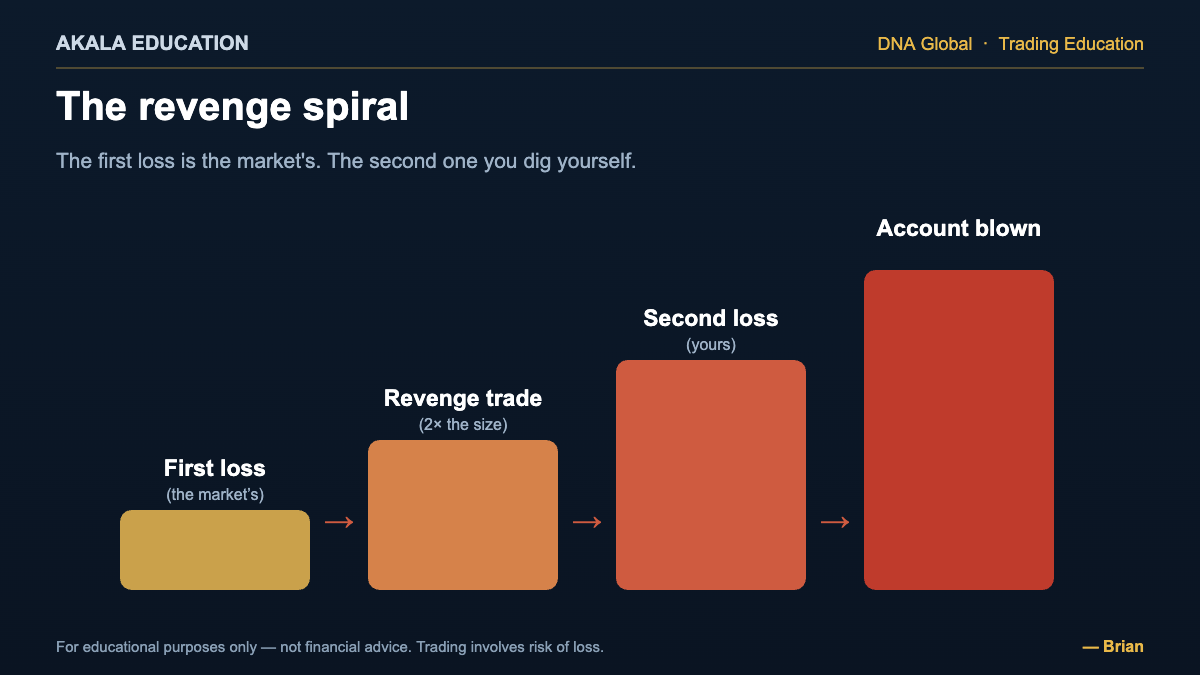
A few hours earlier, I’d opened a trade several times heavier than usual. Not because I felt more certain. Because I wanted to win it all back that same day — fast. When the price went against me, I piled on more to “average down,” then opened a revenge trade the other way. By the end, I couldn’t bring myself to open my banking app. I was hiding the number from myself.
And in the middle of that night, the question I feared most crept in: maybe I just don’t have what it takes. Maybe some people are born for this, and I’m not.
If you’ve ever sat in front of a red screen at first light — your hand drifting toward Close, then pulling back — I’m not writing to lecture you. I’m writing because I sat in that exact spot, with that exact feeling in my chest.
It took me a long time, and real money, to see this: I wasn’t blowing up an account because I read the market wrong. Plenty of my trades were pointed the right way. I was blowing up because I entered too heavy — heavy enough that one move against me could wipe out days of gains, and wipe out the person sitting behind the trade too. An account rarely dies from a wrong prediction. It dies from one oversized position, one loss we refuse to cut, one string of revenge trades in a fit of spite.
It turns out the right question was never “do I have what it takes.” It was something else entirely.
Three fears pinning you to the floor — and the truth behind each
I sat with enough nights like that one to understand something: before you lose to the market, you’ve already lost to three fears inside your own head. Let me name each one — because a fear called by its true name shrinks to half the size it had while hiding in the dark.
First: the fear of losing money. It sounds so reasonable nobody bothers to argue. But here’s the part few people say out loud — the thing that kills your account isn’t a single loss. Everyone who trades has red days. What kills you is losing too heavily in one shot, because you were so sure you sized up too far. Losing money isn’t the enemy. Losing control is.
Second: the fear that you don’t have what it takes. This one cuts deeper — it touches your self-respect. But I’ll tell you straight: what separates the trader who lasts from the one who burns out isn’t IQ, isn’t some God-given gift, isn’t reading a chart like a prophet. It’s whether you dare to size small while every cell in your body screams to size big. That’s not talent. It’s a choice — repeated enough times, it becomes who you are.
You’re not short on talent. You’re just betting as if you could never be wrong.
Third: the fear that it’s already too late. So much money gone, so many months drained. But as long as you have capital, you’re still in the game. Capital preservation first, profit later — until the account hits zero, nothing is too late.
New runners often fear they “weren’t built to run.” The truth? They shoot off the line like an arrow and collapse at the fifth kilometer. The problem isn’t their legs. It’s the pace they chose right at the start.
Trading is the same. You don’t need to become a different person. You need to change your pace.
And that was the moment I stopped being a victim of the market and started owning the one part that was actually in my hands.
The day I stopped asking ‘where do I enter’ and started asking ‘how much’
There was one morning I sat down in front of the chart, hand on the mouse — and for the first time, didn’t draw a single line hunting for an entry.
For years before that, my first question was always the same: “Where’s the perfect entry?” I hunted the perfect candle. I drew and redrew support and resistance, as if finding that one narrow crack would make the market swing open and pay me. I believed the entry was everything. Enter right, change your life.
I paid tuition to learn I was asking the wrong question. Because the most beautiful candle in the world, if I entered too heavy, still wiped the account in a single snap against me. A mediocre entry with controlled size let me live to play the next hand. The entry is where I place my hope. The size is where I place my hand.
So I changed the question. Not “where do I enter,” but: “If this trade is wrong — and it absolutely can be — how much do I lose? And can I carry it?”
That question sounds small. But it moved my whole center of gravity. Before, I was a victim: the market took my money, the market decided my fate. After, I became the owner of the only thing I could truly hold in my hand: how much I let myself lose on each trade.
That’s position sizing. Not a trick — a choice. Setting size by the risk per trade I can actually carry — keep it small, keep it fixed, don’t haggle with the greed howling in my head. React, don’t predict. I stopped guessing where the market would go and held my own part tightly: how much I put in, and how steady I stayed when the price went against me.
Like a marathon. The beginner sprints the first kilometer and collapses when his heart can’t take it. The one who finishes is the one who holds his pace — slow enough that at kilometer 42, his heart is still beating.
The entry decides whether you’re right or wrong once. The size decides whether you’re still alive after a hundred times.
Position sizing is the brake that keeps you in the game — your real risk management
There was one thing I avoided looking at squarely for years. Not the chart — my own position size.
I used to think entering light was for the faint of heart. People go in with one, I go in with five — if I’m going to win, I’ll win big. Until the night an utterly ordinary move against me, something that should have been a scratch, took everything I’d gathered over days. I wasn’t on the wrong side. I was simply too heavy — so heavy the market didn’t need to be right for long. It only needed one beat to show me the door.
That was when it broke open in me: position sizing isn’t a technique. It’s a brake.
Have you ever watched a caravan descend a mountain pass? The brake doesn’t let it go one meter faster. But it’s precisely because there’s a brake that people dare to take the descent at all — dare to go far, dare to touch roads a driver with no brakes would never go near. Position sizing is exactly that. It doesn’t help you win faster. It keeps you from being knocked out of the game before the one right trade finally arrives.
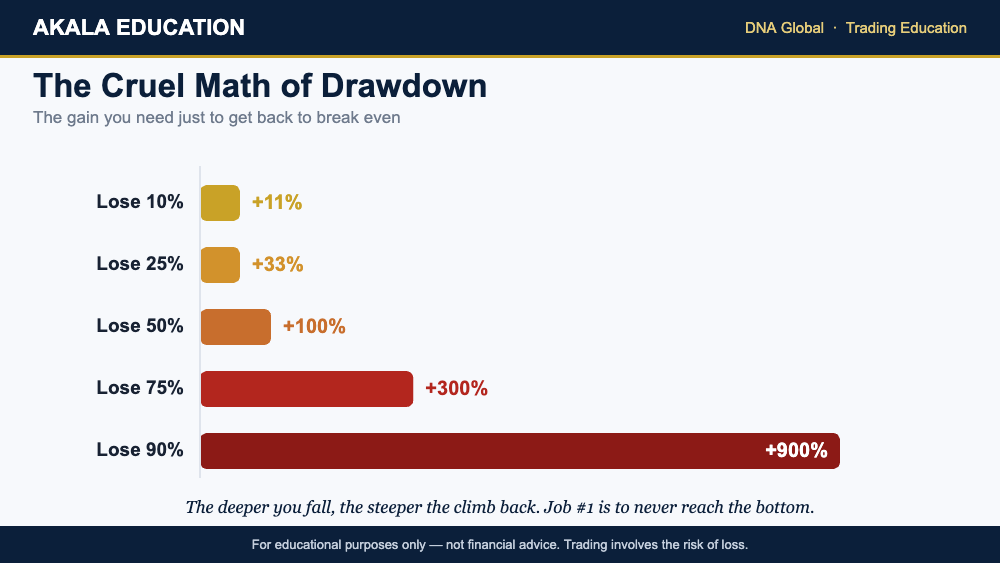
Now for the brutal arithmetic — the part few people want to hear. Lose half your account, and you don’t need a fifty-percent gain to get back. You need to double what’s left. (An illustrative, educational figure — not a recommendation. The math itself is just math.) Every time you go in heavy and you’re wrong, you don’t step back one step — you dig a hole that takes twice the effort to climb out of. The deeper it gets, the easier it becomes to do the dumbest thing of all: grit your teeth and jump into one last trade to win it back. That trade usually carries off whatever was left.
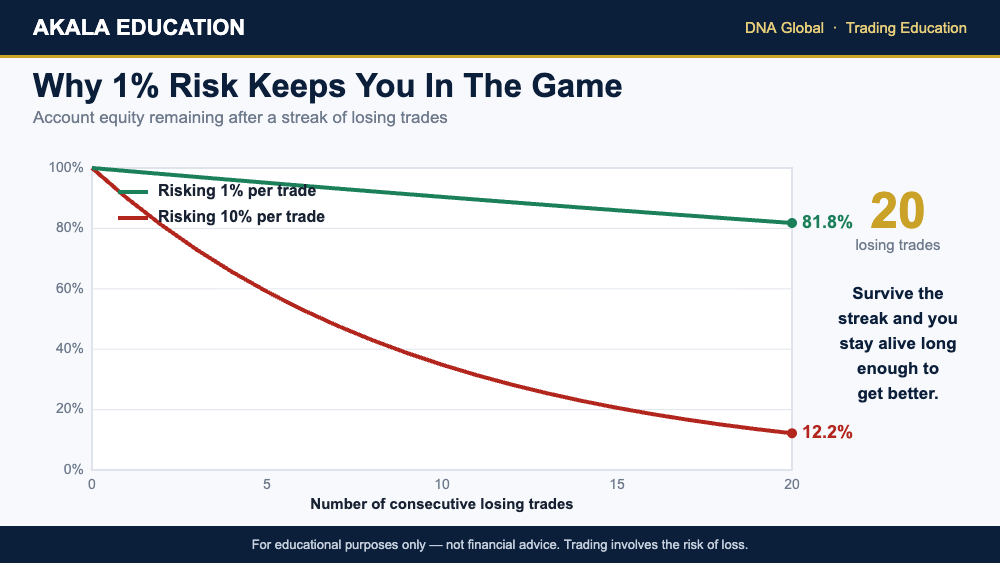
And the losing streak? It always comes, and asks no one’s permission. Five, six, seven losses in a row aren’t bad luck — they’re probability, the very gut of this game. The trader who lasts isn’t the one who dodges the streak. It’s the one who keeps the risk per trade small enough and fixed enough that the whole streak passes through and the account is still breathing on the other side.
Capital preservation first. Profit comes later. As long as you have capital, you’re still at the table — and as long as you’re at the table, the right trade will eventually come around to you. This is what money management actually is — not a clever entry, but a fixed, small bet you can repeat through every streak the game throws at you.
One loss must never be allowed to erase ten wins
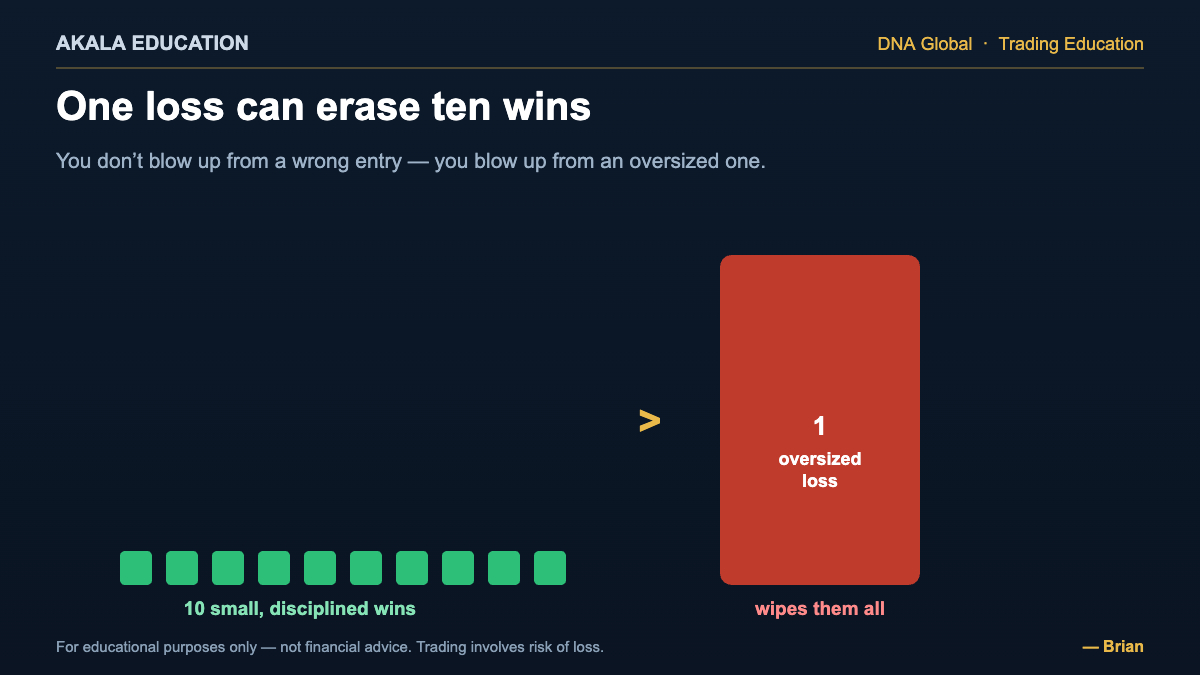
Let’s be honest with each other: you don’t lose because you’re bad at this. Everyone in this game loses — I lose, you lose, the manager of a large fund loses. Losing is part of a probability game, not a verdict on the incompetent. The problem is not that you lost. It’s that one of your losses was heavy enough to swallow the work of the ten wins before it.
I was that person. A whole week of patience, gathering profit a little at a time. Then one night the emotion rose and I entered a trade far too heavy — minutes later, days of accumulation evaporated. I wasn’t wrong ten times. I was right many times, then wrong ONCE with the size of someone who believed he could never be wrong.
That voice in your head, “I have to win it back now” — that’s the voice of the victim. The voice that says “cut the size down, wait for more” — that’s the voice of the owner.
It’s like when I was learning to swim. The harder you yank one big stroke to pull ahead, the more you wreck your breathing, and then you sink. Swimming far doesn’t belong to the strongest. It belongs to the one who keeps his form when he’s already tired — no straining, no rushing.
You don’t need to win more. You just need to keep each loss from being big enough to drag down the times you already won. You don’t beat the market. You beat the impatient version of yourself — the one who always wants to win it all back in a single trade.
From victim of the market to owner of the board
Let’s be honest. How many invitations like these have you scrolled past: “3x your account in a month,” “this one’s a sure thing,” “signals accurate 95% of the time”? Me too. And I once believed all of it.
It took me a long time to understand: those aren’t invitations to get rich. They’re a language that keeps you in the victim’s seat. There is no sure-win signal — and the people promising one are selling you the seat, not the freedom. The moment you believe there’s a “sure thing” out there, you’ve quietly handed your account’s fate to the market to decide, and you sit and ask: “Today, does the market feed me, or take from me?” That’s the question of someone waiting to be handed something.
Risk management is the first action that pulls you out of that chair. Because for the first time, you stop asking what the market will do to you and turn to tell yourself: “On this trade, the most I’ll let the market take from me is this much.” It sounds small. But it’s a whole reversal of power — from the one being taken from, to the one who decides how much may be taken.
The owner doesn’t ask how much the market will give them. They decide how much they’re willing to lose.
I paid tuition to understand that what comes fast usually leaves fast — and usually carries off the capital you scraped together over months. The Porsche 911 I once dreamed of was never the destination. It’s just a reminder taped in front of me: what lasts is built from one right thing repeated every day, not from a single all-in left to chance. It’s the same lesson photography taught me — a good frame comes from knowing what to leave out. A clean trading plan, like a clean photograph, is mostly about what you have the discipline not to do.
And here’s what I believe after all of it: alone you go fast, but with a system and a team you go far. I didn’t build DNA Global to be a signal-calling star for someone to admire. I built it because the journey from victim to owner — walked together — is less lonely, and fewer people collapse halfway up the climb. You don’t need a prodigy to show you the way. You need a map, and a few companions who once crawled up that exact stretch of slope.
Tonight, do this one small thing
You’ve read this far. Don’t let it dissolve into tomorrow.
Tonight, before your next trade — just one trade — stop for three seconds. Ask yourself: “If this trade loses, will it hurt?”
If yes, the problem isn’t the entry. It’s the size. You’re betting heavier than your nerves can carry. Bring it down — down to the point where, even if the price slaps you straight across the face, you still shut the laptop, brush your teeth, and go to sleep. Not because you won, but because you have nothing left to fear. That’s not surrender. That’s the owner setting his own limit before the market sets it for him.
A loss that keeps you up all night isn’t a trade anymore — it’s a gamble. And a gamble has no place in a craft built for the long road.
This whole article fits in one thing you can do tonight: risk small, last long. Because risk management isn’t one technique in the trade — it’s the only way you stay in the market long enough for the right trade to find you. As long as you have capital, you’re still at the table. And as long as you’re at the table, the right trade still has a road to reach you. (If the click to cut is where you keep losing the discipline, I wrote about that too, in The Hardest Click Is the Stop Loss.)
I’m not writing this so you’ll admire me. I’m writing so you’ll see yourself — and know you’re not walking alone. If you’d like a companion for the road, I left a playbook I wrote myself, free: “Money Management in Trading” — with a checklist of 7 questions to ask before you press the button. Print it. Tape it next to your screen. Think of it as someone sitting beside you, quietly nudging you to stop at the right moment.
And the question I’ll leave you with, the one to bring you back, is simple: tonight, will you sleep easy?
— Brian
About the author
Brian — founder of DNA Global, a community that trains and walks alongside Forex/XAUUSD traders. I didn’t come to this craft by a pretty road. I once believed “the right entry changes your life,” once sized up on emotion, once lost and paid my tuition in real money and sleepless nights. Those stumbles taught me that capital, emotion, and discipline are the deciding parts — not the perfect candle. I chose to build a SYSTEM and a community of companions, instead of being a signal-calling star. Off the charts, I run marathons and I swim — the two places that taught me most clearly that the one who finishes isn’t the strongest, but the one who holds his pace.
Forex/XAUUSD trading always carries the risk of losing capital. This article shares personal experience and is educational in nature — it is not investment advice or a buy/sell signal.
FAQ
What is risk management in trading?
It’s deciding, before each trade, the most you’re willing to lose, then choosing a position size that matches that exact amount. The core goal isn’t to maximize the win — it’s capital preservation, surviving the losing streaks that will certainly come.
Is position sizing really more important than the entry?
In my experience, yes. A beautiful entry with too-heavy size can still wipe the account in a single snap against you; a mediocre entry with controlled size lets you live to play the next hand. The entry decides whether you’re right or wrong once — the size decides whether you’re still alive after a hundred times.
How much should I risk per trade?
This article doesn’t hand you a specific number as a recommendation, because the right amount differs from person to person and account to account. The qualitative principle: keep the risk per trade SMALL and FIXED — small enough that a run of five, six, seven losses in a row can pass through and the account is still breathing.
How do I stop sizing up on emotion?
One simple step: before you press the button, pause three seconds and ask, “if this trade loses, will it hurt?” If yes, bring the size down to the level where you sleep easy even if it loses. Setting your own limit before the market sets it for you is the heart of money management.
Trading always carries the risk of losing capital. This article shares experience and is educational in nature — it is not investment advice.