

New
Six Years to Learn One Word: Survive — the Story of a Losing Trader

I’m not writing this for the people who are winning. I’m writing it for the version of me from the early days — the one sitting in front of a chart at midnight, wondering where he went wrong.
Two in the morning, New York session. The room is dark; only the screen glows. On the chart, a red XAUUSD candle drives straight down — and my position sits on the wrong side of it.
The cursor hovers over the close button. It doesn’t click.
Instead, I drag my stop loss down another notch. Which time that night? I’ve lost count — I only remember muttering: “Price will come back.”
It took me years to call that action by its real name: dragging your stop loss isn’t trading — it’s the politest way a trader lies to himself.
That night, I wasn’t afraid of losing money. I was afraid of something worse: watching exactly how I was going to lose, and being unable to stop.
If you’ve ever sat like that — hand on the mouse, unable to click — this story is for you. I sat there longer than I’d like to admit.
The early days: hunting for the “life-changing entry” on the gold chart
To understand that night, I have to start from the beginning.
I came to XAUUSD gold trading the way most people do: carrying a belief so simple it was naive — find the right entry point, and your life changes. I memorized every candlestick pattern. Drew dozens of trendlines. Stacked indicator on top of indicator like someone taping lucky charms to a door.
There was just one question I never asked: “What if I’m wrong?”
Years later, holding a camera, I finally understood who I was back then. Beginners in photography believe an expensive lens produces beautiful photos. It doesn’t — a beautiful photo comes from an eye that knows what to leave out. Traders are the same: it’s not the indicator that produces the result. It’s the person behind the screen.
Newcomers walk into the market to learn how to win. Nobody tells them the first lesson — the survival lesson — is how not to disappear.
Naivety isn’t a crime — staying naive too long is what costs you. And the market never forgets to send the bill.
Blowing the account: when your money and your confidence go down together
The bill arrived. Not in one day — over many.
The position sank deeper than the level I’d promised myself I would cut. I sat still and did nothing. Held. Waited. Hoped.
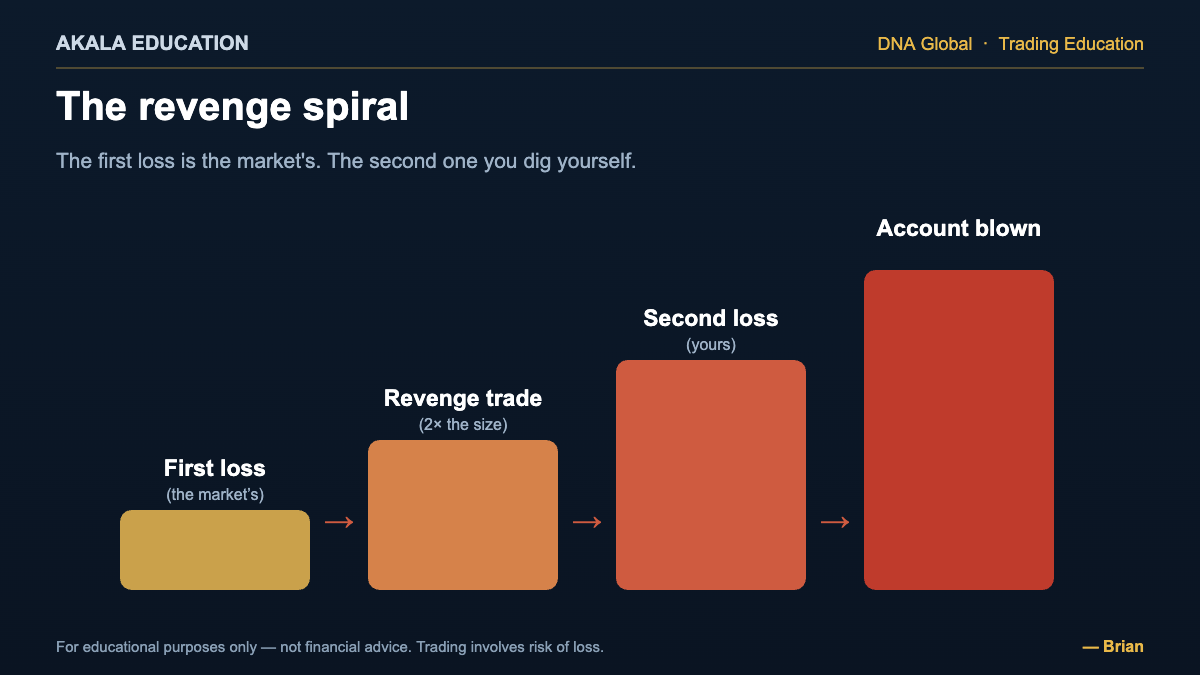
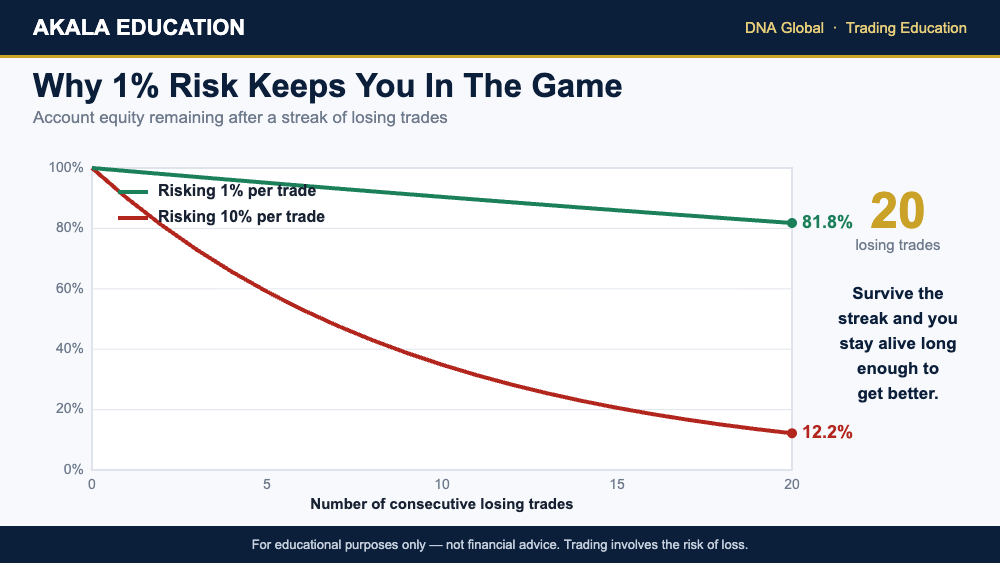
A blown trading account doesn’t happen in a single moment. It happens in a series of small decisions you know are wrong — and make anyway. Widen the stop loss a little. Add one more trade to “win it back.” Promise yourself this is the last time. Then promise again.
The worst part wasn’t the account approaching zero — it was the nights that followed. Not daring to open the app. Not daring to tell anyone. Laughing and chatting normally by day; lying awake at night asking where it all went wrong.
Because back then I blamed the news, the whales, the market — everything except myself. Blame feels better than a mirror, but it refunds nothing.
The most expensive tuition I ever paid isn’t on any account statement: lost money can be deposited again, but confidence falls away piece by piece — and it falls without a sound.
If you’re inside nights like those right now: my deepest regret isn’t the losing trades — it’s how long I took to turn the arrow of blame back toward myself.
The realization: the entry point was never the problem
One weekend evening, with the market closed, I opened my trade history — every losing trade. Not to grieve. To look straight at it.
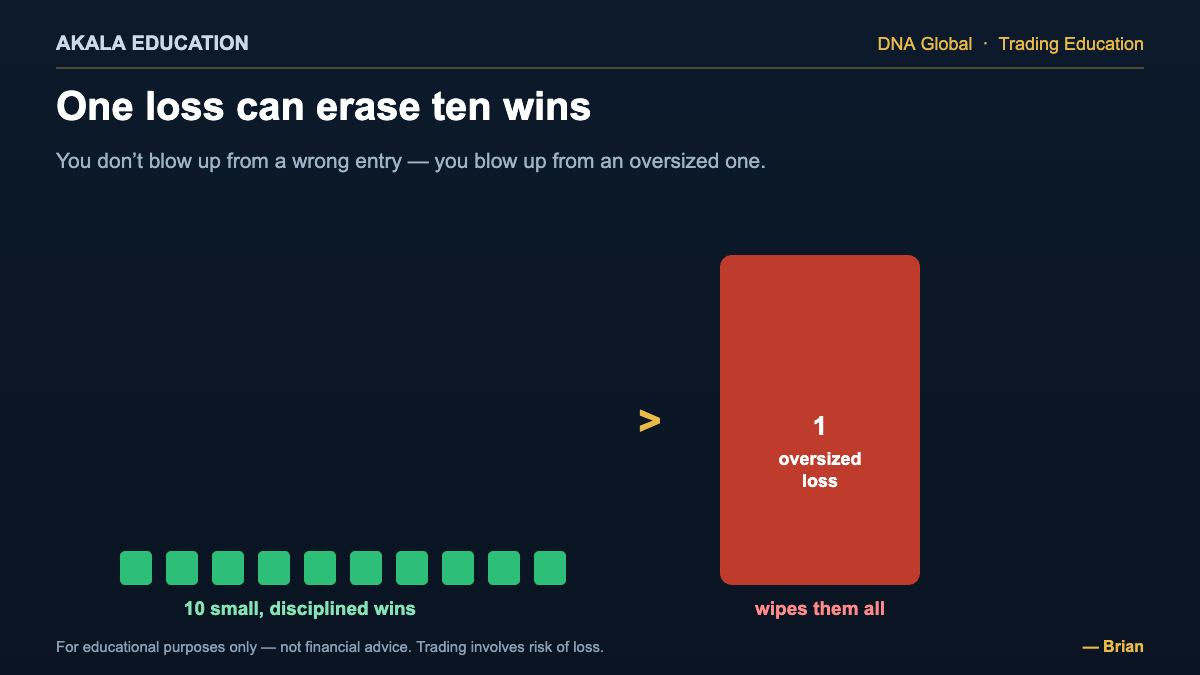
An uncomfortable truth emerged: most of those entries weren’t bad at all. Some were genuinely good. What killed my account were two entirely different things — position sizes far too large for the capital I had, and a hand that refused to cut when the market had made itself clear: you’re wrong.
All that time, I’d been fixing the wrong thing. I thought I needed a better entry method. I DIDN’T. I needed a system that kept me alive long enough.
The entry decides one trade. Risk management and trading psychology decide your whole career.
From that night on, I’ve kept three rules — six years now, and I’ve found nothing more important:
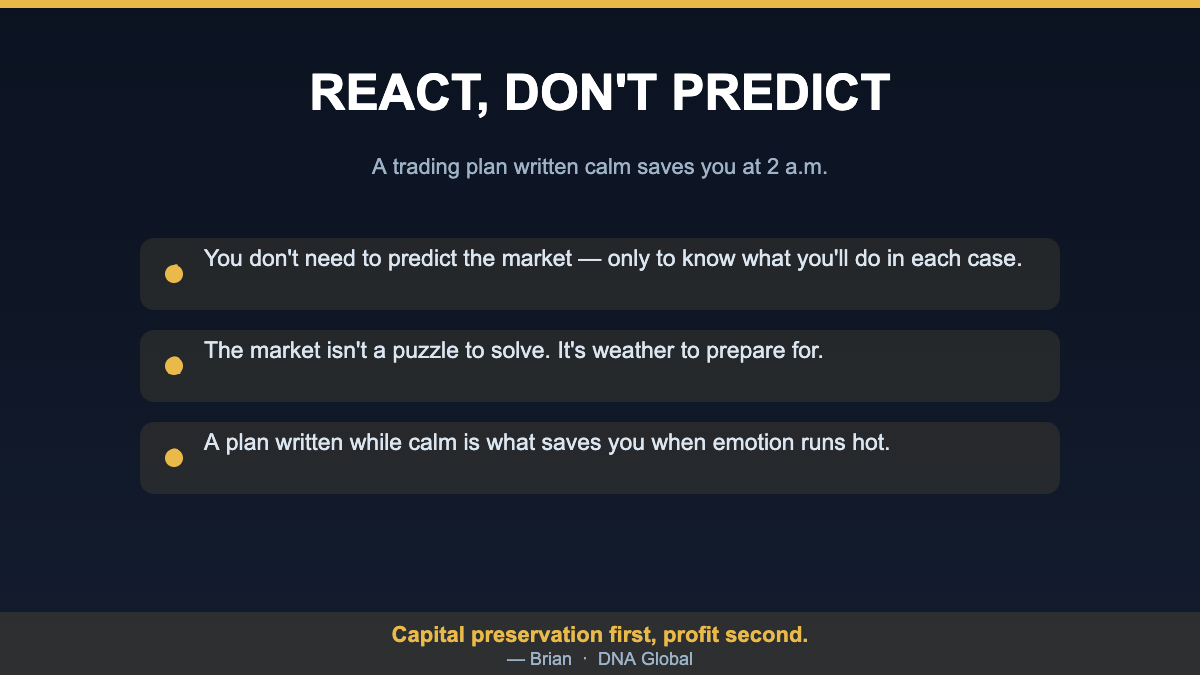
Capital preservation first, profit second. As long as you have capital, you’re still in the game. Lose it, and however brilliant your analysis is, you’re just a commentator standing outside the stadium.
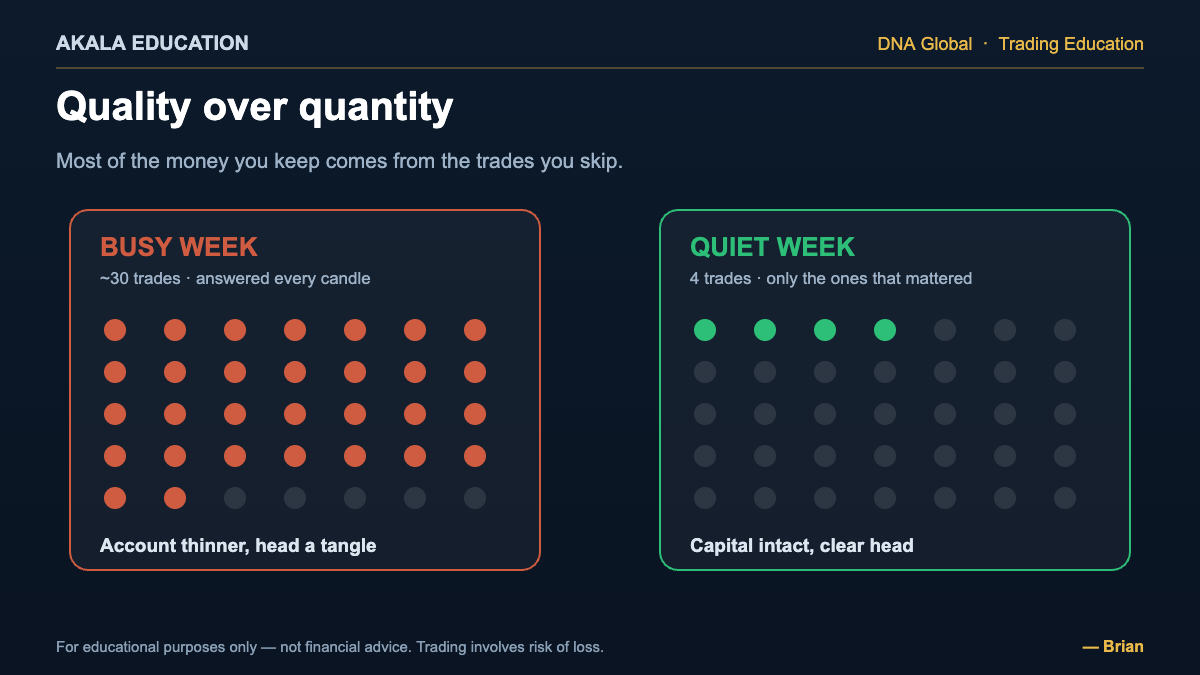
Discipline instead of inspiration. Inspiration urges you to jump in when a setup looks “juicy.” Discipline keeps you out when the trade doesn’t belong to your system. The pain of standing aside is far cheaper than the pain of a blown account.
React, don’t predict. You can’t control the next candle. You can only control what you do with it.
It’s like when I learned to swim: beginners tense their whole body because they’re afraid of sinking — and that very tension is what pulls them under. The swimmers who go far aren’t stronger than anyone. They just breathe in rhythm and hold their form.
Rebuilding from zero: trading discipline at the mile where you want to quit
I started over with things so small that anyone hearing them would be disappointed. Stop loss set before entering the trade — not after. Fixed position size, even on the days I was most “certain” I was right. A trading journal, including the trades I was too ashamed to reread. Leaving the desk on schedule, even when the market ran as if it were tugging at my sleeve to stay.
Nothing on that list glitters — which is exactly why so few people do it. But my trading discipline began with precisely those boring lines.
Around the same period, I started running before dawn. Empty roads. Cold. No applause. Anyone who runs long distances knows: there is always a “mile where you want to quit” — legs like lead, and a mind that starts negotiating with very reasonable-sounding excuses. A losing streak is exactly that mile. The people who finish aren’t the fastest runners — they’re the ones who don’t stop to negotiate at that particular mile.
Discipline isn’t born on the days you feel great. It’s born at the mile where you want to quit.
The evening I turned off the screen: the question that gave birth to DNA Global
Discipline kept me alive. But there was one question it couldn’t answer.
One evening after the session, I turned off the screen. The room went fully dark, just the hum of the computer fan — and a question surfaced, clearer than any chart I’d ever read:
“If I stop tomorrow, does anything I’ve built still exist?”
I sat still for a long time. Because the answer was: no.
For years, I hadn’t been building a career — only a name. And that name stood on exactly one pair of legs: mine. If I got tired, it fell.
That night I chose my road. I would not become a “signal-calling star” — the person a crowd waits on for every message. I would build a system: clear processes, those who walked the road earlier guiding those who come after. The repetitive work, machines can carry. The work machines can’t do — sitting beside someone who just blew their account, listening until they’ve said everything — people keep.
Stars burn out. Systems stay lit — even on the nights you’re at your weakest. And inside a system, you’re not required to get better in solitude.
DNA Global was born that evening.
Today: writing for the person sitting in front of the screen like I once did
Six years with XAUUSD, and I still read charts every day. But what I read longer are the messages inside DNA Global’s Telegram community. Over 200,000 followers — and let me be straight, that is not 200,000 customers. Many of them are losing, holding onto sinking positions, sitting in exactly the chair I sat in at two in the morning.
That midnight room still exists. Only the person sitting in it has changed.
So I have nothing to promise you. Get-rich-quick? I’ve paid more than enough tuition to know it doesn’t exist. What I have is only this: honest knowledge, a system solid enough to hold onto on the days your hands shake, and people willing to sit beside you when your account is red. My job isn’t to teach you to beat the market — it’s to help you walk the road I walked: from being a victim of every candle, to being the owner of your own mind first. The market can wait.
And the Porsche, the photos I take, the caravan trips with friends? They’re not a destination I’m inviting you to chase — just reminders that the beautiful things only agree to arrive once you stop chasing them and go back to doing the right work every day.
If you’re a losing trader: three fears, and one thing you can do tonight
If you’ve read this far with an account in the red, I’d guess you’re carrying three fears. I lay awake with all three.
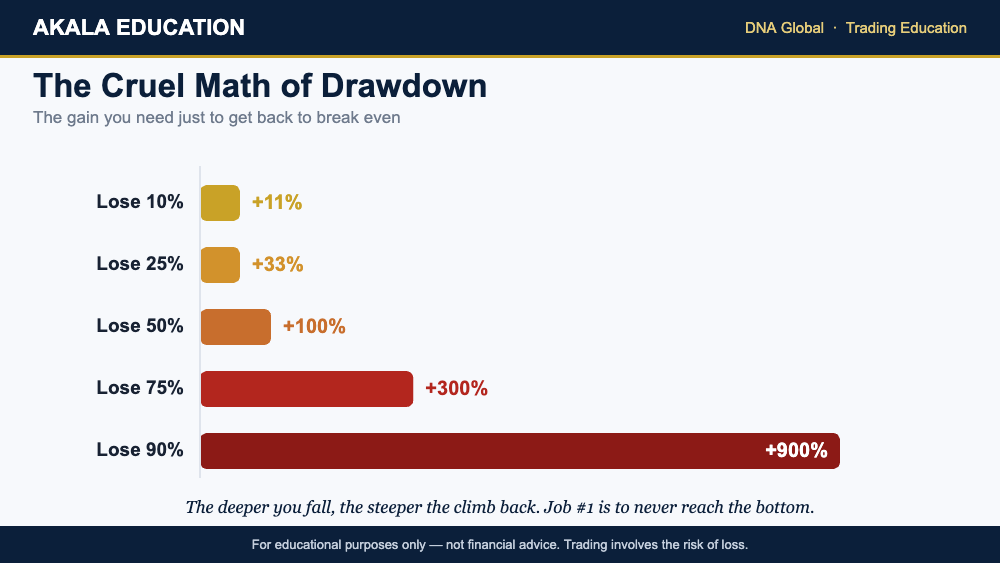
First: the fear of losing more money. Fair. But on the night I described at the start, the thing killing me wasn’t the market — it was the hand that refused to cut the trade. Money isn’t lost for lack of luck. Money is lost for lack of rules.
Second: the fear that you don’t have the talent. I believed that too — until the day I listed everything that made me lose: oversized positions, holding losers, entering trades out of frustration. Not one line was innate. All of it was habit. And habits can be fixed.
Third: the fear that it’s too late. Looking back over six years, I see the opposite — entering the market late never made anyone disappear. Leaving it early did.
You don’t need to win this week. You only need to make sure that next year you’re still here — intact, and clearer-headed than today.
So tonight, just one thing. Not a trade. Turn off the screen — the way I once did. Rest for a few days. Take a sheet of paper and write your own three rules of capital preservation — by hand, taped somewhere you can’t avoid seeing tomorrow morning. Then find a decent community, because nobody should walk this stretch of road alone.
Six years, and the market never taught me how to win. It taught me one word: survive. You aren’t missing one more secret strategy. You’re missing a reason to stay — and staying is a thing you can learn.
Whenever you’re ready, come by the DNA Global community — sit down, breathe first, and then we’ll keep going together.
— Brian
About the author: Brian — founder of DNA Global, with 6 years of specialized experience in the XAUUSD gold market and builder of a Telegram community of more than 200,000 free followers. He lost, paid his tuition in money and confidence, then chose the road of building a system — clear processes, a well-trained team, those ahead guiding those behind — to walk alongside traders. Away from the charts, Brian runs marathons and swims — two sports that taught him more about trading than any book.
Frequently asked questions
Does blowing my trading account mean I don’t have the talent for trading?
No. Most losing traders lose because of risk management and trading psychology — things that can be learned and fixed — not because of missing innate talent.
Is it too late to start over after heavy losses?
The only “too late” is leaving for good. Coming back with clear capital-preservation rules always beats continuing to trade without rules.
Is the entry point the main reason traders lose?
In my experience: no. The entry decides one trade; risk management and emotions decide your whole career.
What should I do first right after blowing an account?
Stop trading for at least a few days, review your trade journal for repeating mistakes, and write down your own risk-management rules before depositing another dollar.
Trading Forex/XAUUSD with leverage always carries the risk of losing your capital; this article is educational and shares personal experience — it is not investment advice or an invitation to trade.